

What is Ecosocialism?

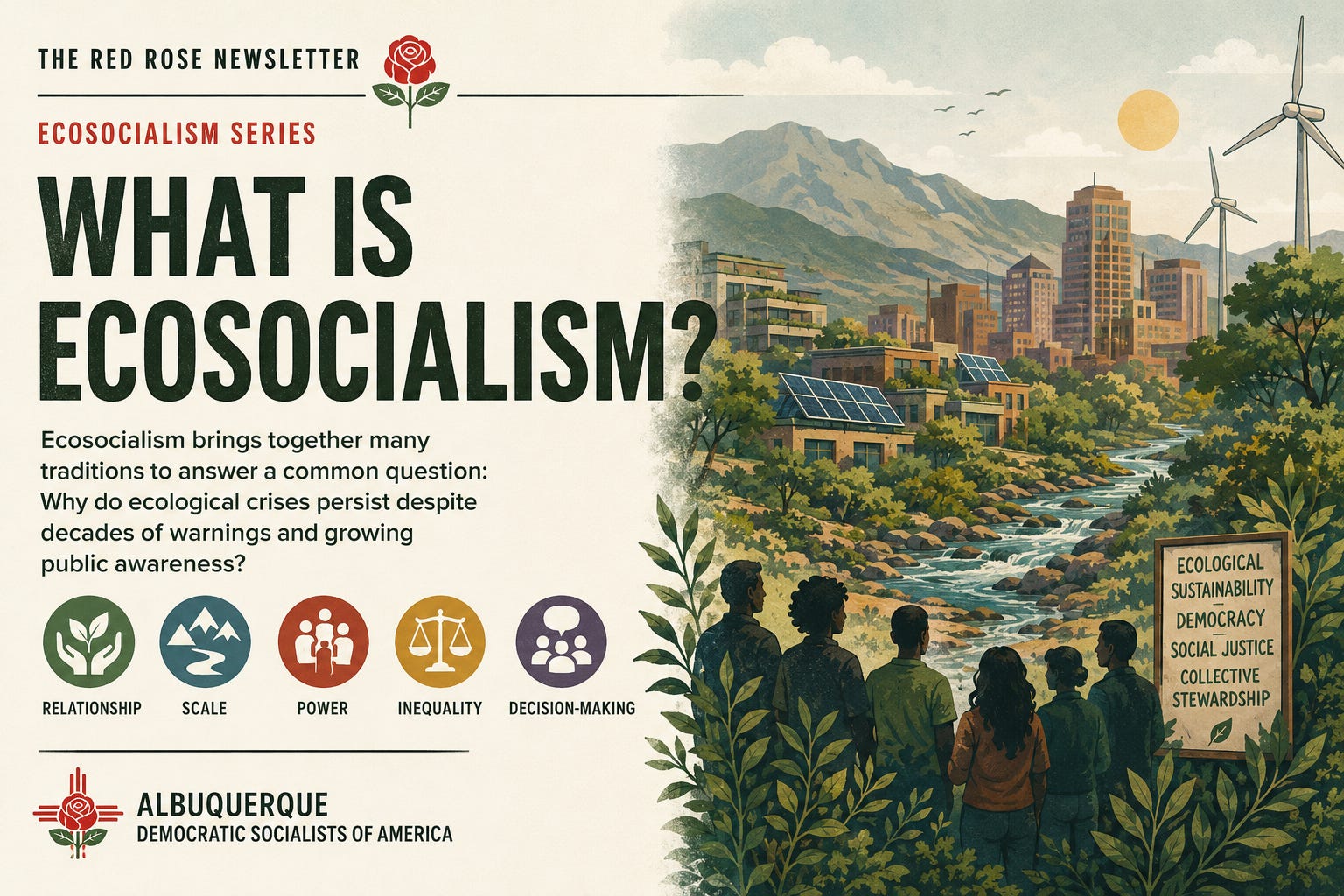
Few people would argue that climate change, pollution, drought, or biodiversity loss are imaginary problems. Public awareness is higher than it was a generation ago. Scientific knowledge is greater. Governments have adopted laws and policies intended to address ecological challenges. Yet ecological crises continue to deepen.
Why has growing awareness not produced commensurate change?
Different people offer different explanations. Some point to political institutions that struggle to address social-ecological issues operating across large landscapes and long time horizons. Others point to economic systems that reward short-term gain over long-term sustainability. Still others argue that social-ecological issues cannot be separated from questions of democracy, justice, ownership, and power.
These debates have produced one of the most important political and ecological conversations of the last several decades: ecosocialism.
In the first article in this series, From the Green New Deal to Ecosocialism: A Growing Discussion within DSA, we explored how ecosocialism has emerged as an increasingly important topic within our organization.
This article asks a different question: What exactly is ecosocialism?
The answer begins long before the word itself entered political discussion.
Ecosocialism did not emerge from a single thinker, organization, or movement. It developed from several traditions that were grappling with a similar question:
Why do ecological crises persist despite decades of warnings and growing public awareness?
Each tradition illuminated a different aspect of that challenge.
Relationship
One perspective focuses on humanity’s relationship to the natural world.
Long before modern environmental movements emerged, Indigenous peoples around the world developed systems of stewardship rooted in reciprocal relationships between human communities and the lands and waters upon which they depended (Kimmerer, 2013). From this perspective, ecological crises are not simply technical problems to be solved. They are also questions about how human communities understand their place within the natural world.
Scale
Another perspective focuses on scale.
Beginning in the 1970s, writers such as Peter Berg and Raymond Dasmann observed that ecological systems do not follow political boundaries (Berg & Dasmann, 1977). If ecological systems operate at one scale while political institutions operate at another, how should societies make decisions that reflect ecological realities? From this perspective, ecological crises persist in part because the decision-making systems people use often do not align with the ecological systems they are trying to manage.
Power
A third perspective examines power.
Murray Bookchin argued that ecological crises could not be separated from broader questions of hierarchy, domination, and social organization (Bookchin, 1982). In his view, environmental degradation was connected to how societies organize power and human relationships (Bookchin, 1982; Bookchin, 1990). If power shapes relationships among people, might it also shape how societies relate to the natural world?
Bookchin’s social ecology became one of the most important efforts to connect ecological sustainability with democracy and participatory decision-making (Bookchin, 1990). From this perspective, ecological crises are shaped not only by science and technology but also by the social and political systems through which decisions are made.
Inequality
Another perspective focuses on inequality.
Environmental justice advocates observed that environmental harms are rarely distributed equally across society. These harms often fall disproportionately on marginalized communities (Bullard, 2000). If environmental problems affect communities differently, who benefits from existing social and economic arrangements, and who bears the costs?
Environmental justice highlighted the relationship between ecological sustainability and social justice (Bullard, 2000). From this perspective, ecological crises persist not only because ecosystems are being degraded, but because the costs and benefits of environmental decisions are often distributed unevenly across society.
Decision-Making
A fifth perspective focuses on economic decision-making.
As environmental thinkers examined the ecological consequences of economic activity, many began asking who controls the systems that shape everyday life (Kovel & Löwy, 2001; Löwy, 2018). If economic decisions shape ecological outcomes, who should have a voice in making those decisions?
This question helped generate interest in forms of democratic control over economic institutions (Schweickart, 2002; Wright, 2010; Restakis, 2010). From this perspective, ecological crises persist in part because many decisions with profound environmental consequences remain insulated from democratic participation and accountability (Schweickart, 2002; Wright, 2010).
Bringing The Perspectives Together
Taken together, these traditions illuminated different aspects of the same problem and offered different explanations for why ecological crises persist. They also raised practical questions. If societies are to make decisions differently, how should those decisions actually be made? How can diverse communities work together across landscapes, watersheds, and regions to address shared ecological challenges? How should ecological priorities be identified, debated, and acted upon in democratic ways?
Ecosocialism emerged as one effort to bring many of these perspectives into a common political, economic, ecological, and democratic framework. Rather than treating ecological crises as isolated environmental problems, ecosocialists increasingly argued that sustainability, democracy, justice, stewardship, and economic organization must be considered together.
One of the most influential statements of this effort appeared in 2001 with the publication of An Ecosocialist Manifesto by Joel Kovel and Michael Löwy (Kovel & Löwy, 2001). The manifesto argued that ecological crises are rooted in how societies organize economic activity and relate to the natural world. From this perspective, environmental crises persist because they are embedded within broader social and economic relationships rather than existing as separate environmental issues (Kovel & Löwy, 2001).
The manifesto did not provide a detailed blueprint for a future society. Instead, it helped establish a common framework for understanding ecological sustainability, democracy, social justice, and economic organization as interconnected concerns rather than separate political issues (Kovel & Löwy, 2001). In doing so, it became one of the foundational texts of modern ecosocialism.
Ecosocialism Today
As ecosocialist ideas spread, they increasingly moved beyond academic and activist circles in Europe and North America. The 2009 Belém Ecosocialist Declaration reflected this broader international perspective (International Ecosocialist Network, 2009). Drafted by activists and movements from numerous countries, the Declaration presented ecosocialism as a global response to shared ecological and social challenges (International Ecosocialist Network, 2009).
It emphasized that ecological and social challenges transcend national borders and require international cooperation, democratic participation, and socially just responses (International Ecosocialist Network, 2009). More importantly, the Declaration demonstrated that ecosocialism had become an international political and intellectual current rather than a discussion limited to a handful of writers and organizations.
Among contemporary additions to the subject, Michael Löwy’s Why Ecosocialism: For a Red-Green Future provides one of the clearest explanations of ecosocialism for general audiences (Löwy, 2018). Löwy describes ecosocialism as an effort to bring ecological sustainability, democracy, social justice, and collective responsibility into a common framework (Löwy, 2018).
Löwy also highlights a concept that appears throughout contemporary ecosocialist thought: democratic ecological planning. In his view, ecological sustainability cannot be left solely to markets, private corporations, bureaucracies, or technological innovation. Communities should play a meaningful role in determining economic priorities and ecological futures through democratic decision-making (Löwy, 2018; Löwy, 2020).
Exactly how democratic ecological planning should unfold remains a subject of debate. Nevertheless, the idea that ecological decisions should be made democratically rather than left exclusively to markets or centralized authorities has become an important theme within ecosocialist discussions (Löwy, 2018; Löwy, 2020).
This helps explain why ecosocialism can be difficult to define. It is a broad tradition that seeks to understand ecological challenges in relation to economic systems, political power, democratic participation, social justice, and humanity’s relationship with the natural world.
Some contemporary discussions intersect with degrowth perspectives. Writers such as Jason Hickel and Giorgos Kallis question whether endless economic expansion can remain compatible with finite ecological systems (Hickel, 2020; Kallis, 2018). Although not all ecosocialists embrace degrowth, the two traditions engage many of the same questions.
Democratic socialist writers such as Naomi Klein have helped bring related questions into broader public discussion. In This Changes Everything: Capitalism vs. the Climate, Klein argues that climate change must also be understood in relation to economic systems, political power, and social organization (Klein, 2014). Her work has helped popularize many of the same questions that animate ecosocialist discussions.
This diversity of perspectives highlights an important point.
What Comes Next?
Ecosocialism is not a single doctrine. Ecosocialists often debate strategy, institutions, ownership, governance, and implementation. What unites them is a shared effort to address questions of relationship, scale, power, inequality, and democratic decision-making while pursuing ecological sustainability and social justice. Ecosocialism represents one effort to rethink those relationships.
For many DSA members, these questions first emerged through Green New Deal organizing. As discussed in the first article of this series, DSA appears to be moving toward a broader ecosocialist framework and has begun a formal national transition process.
Yet understanding ecosocialism conceptually is only part of the conversation. Ideas become meaningful when they encounter real communities, real economies, and real landscapes.
The questions introduced throughout this article do not exist in the abstract. They arise wherever people must make decisions about water, energy, housing, transportation, land use, economic development, and stewardship of the places they call home. They raise practical questions about who participates in those decisions, how competing needs are balanced, and how communities can pursue both ecological sustainability and social justice.
They also raise questions of scale. Some social-ecological challenges are experienced within counties and local communities. Others unfold across states. Still others emerge across watersheds and broader ecological regions that do not follow political boundaries. Determining the appropriate scale of decisions and how communities can participate in shaping them is itself part of the challenge.
These questions are particularly relevant in New Mexico. Water scarcity, climate change, energy transition, housing affordability, public infrastructure, and economic inequality are experienced locally, influenced by statewide policies, and shaped by ecological systems that extend far beyond any single jurisdiction.
The next article in this series will explore what ecosocialism might mean for Bernalillo County, the state of New Mexico, and the broader ecoregions in which we live, and how these questions of ecology, democracy, scale, and others might inform the work of our local chapter and the communities we serve.
References
Berg, P., & Dasmann, R. (1977). Reinhabiting California. In V. Andruss, C. Plant, J. Plant, & E. Wright (Eds.), Home! A bioregional reader (pp. 35–42). New Society Publishers.
Bookchin, M. (1982). The ecology of freedom: The emergence and dissolution of hierarchy. Cheshire Books.
Bookchin, M. (1990). Remaking society: Pathways to a green future. South End Press.
Bullard, R. D. (2000). Dumping in Dixie: Race, class, and environmental quality (3rd ed.). Westview Press.
Hickel, J. (2020). Less is more: How degrowth will save the world. William Heinemann.
International Ecosocialist Network. (2009). The Belém ecosocialist declaration. Climate & Capitalism. climateandcapitalism.com
Kallis, G. (2018). Degrowth. Agenda Publishing.
Kimmerer, R. W. (2013). Braiding sweetgrass: Indigenous wisdom, scientific knowledge and the teachings of plants. Milkweed Editions.
Klein, N. (2014). This changes everything: Capitalism vs. the climate. Simon & Schuster.
Kovel, J., & Löwy, M. (2001). An ecosocialist manifesto. Capitalism Nature Socialism, 12(1), 1–13.
Löwy, M. (2018). Why ecosocialism: For a red-green future. Haymarket Books.
Löwy, M. (2020). Ecosocialism: A radical alternative to capitalist catastrophe (2nd ed.). Haymarket Books.
Restakis, J. (2010). Humanizing the economy: Co-operatives in the age of capital. New Society Publishers.
Schweickart, D. (2002). After capitalism. Rowman & Littlefield.
Whyte, K. P. (2017). Indigenous climate change studies: Indigenizing futures, decolonizing the Anthropocene. English Language Notes, 55(1–2), 153–162. https://doi.org/10.1215/00138282-55.1-2.153
Wright, E. O. (2010). Envisioning real utopias. Verso.